

We have already discussed how to form an FTC team (see the first article “Transitioning from FLL to FTC: Forming a Team“) and the basic hardware and software FTC robots use to compete (see the second article “Transitioning from FLL to FTC: Team Robot“).
Now in this third article of this series, we are going to discuss the changes and similarities between FLL and FTC in the robot game. We will get started by discussing the field, then we will discuss points and penalties, and lastly, we will talk about how teams are compared in the rankings.
Robot Game Basics
Before we start talking about the robot game too much (especially if you have never seen a FIRST Tech Challenge match before), you may want to see a robot game match. Below is a video of our League Tournament Finals Match 1 from the FREIGHT FRENZY 2021-2022 season (this is the same video from the sneak peek from the first article in this series).
Field
Anyone who has seen FTC robots and robot matches knows that the robot game is very different from FLL. The first difference you might notice is the field size. Official FTC matches are played on a 12ft. by 12ft. field on the floor covered in soft tiles from AndyMark and bordered by perimeter walls also from AndyMark.
The field tiles and walls are expensive (described in the budget in a previous article), but do not be alarmed; many teams do fine having their team’s practice field with cheaper field tiles and walls they fabricate themselves (FIRST has a guide for a DIY perimeter). Perimeter walls of some type are necessary for safety, and we would advise having foam tiles—even if they are from your local hardware or warehouse store—since running your robot on hard floors or carpet long-term damages the wheels (and maybe your floor!) and makes the autonomous portion of the game at competition (with official Soft Tiles) harder to plan for. Do whatever is in your budget.
The field is also quite large! Most community teams and some school teams cannot fit the full field in their facility; that’s why AndyMark sells the pieces for the year-specific game for the red and blue alliances, as well as the full field. For the FREIGHT FRENZY season (2021-2022) the competition field was split so that a third was for the red alliance, a third was from the blue alliance, and the last third was shared between alliances, so our team built a two-thirds field (commonly referred to as “half-field” by FTC teams) shown below.
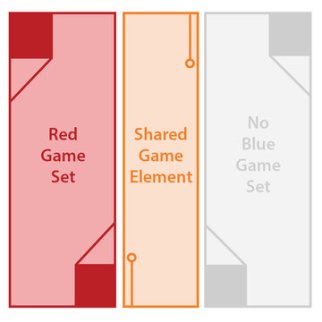
Last season, POWERPLAY (2022-2023), was not spilt rigidly by alliance, but rather all of the field was fair game for scoring. With a smaller field configuration it may be harder for your drive team to drive to the extents of the field during competitions. That said, many teams did perfectly fine with the “half-field” 8ft. by 12ft. setup.
For the CENTERSTAGE season, we will not know how the field is going to be situated until the game release on September 9, 2023. Therefore, it may just be easier to keep in mind locations to setup your field but decide the size of your field after the kickoff.
Lastly, note that, although it can be hard to set up and take down the field each meeting, many successful teams employ this strategy due to space restrictions in their school, host member’s home, etc.
Drive Team
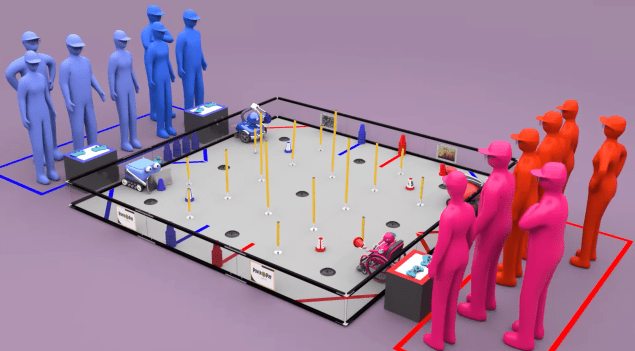
A spectator may also notice that the 4 teams at the field each have 3 members. The FTC drive team is composed of 2 drivers and 1 driver team coach. As in some prior seasons, CENTERSTAGE has an additional 1 alliance human player that interacts with inserting objects into the field space — there is only one human player per alliance. You will decide on your human player with your alliance partner.
FTC technicians are called drivers because that’s what they do–quite literally drive the robot with gaming controllers. The allowed game controllers are listed in the season’s Game Manual 1. Teams may have only 1 driver if they prefer or do not have enough members.
The drive team coach is usually a student team member whose designated role is to watch the field, the timer, and the refs and communicate with the drivers to warn them of undesirable conditions and guide them through the match. In the past, Game Manual 2 clarified that the drive team coach can be an adult mentor. Although using an adult in this role is more rare, depending on the size of your team or confidence of your members, remember that it is a legal option. Should you wish to have an adult coach or mentor be the drive team coach, you may want to carry the game manual ruling with you to the drivers’ box in the case that someone forgot the rule and would like to question you. The rules regarding the drive team coach will be found in Game Manual 2 when it is published on the release of the FTC materials on the season kick-off date (September 9, 2023 this year).
Teams can switch out drive teams for each match, just not in the middle of a match. Teams can also keep their drive team the same for all matches. Just like in FLL, your team has the choice!
Alliances: Red and Blue
Each robot game match has four teams on the field, in contrast to the one (or two if you count the adjoining tables as one field) team(s) on the FLL board. These teams are divided into “alliances.” One alliance is red and the other is blue. The two teams on an alliance work together to earn points to form a combined score, no matter what team actually scored the points.
Teams are expected to strategize and coordinate with their alliance partners before coming to the field to make the most out of scoring for the match and to make sure that the robots do not collide! It helps to have “scouted” the team before talking to them about strategy to already know their strengths and weaknesses. We will discuss “scouting” later in this article. During qualification matches, your alliance partner in one match may be competing against you in another match.
How are alliances chosen? The alliances are randomly chosen for Qualification Matches but are decided by specific high-ranked teams for Elimination Matches in the ending tournament brackets. We will discuss both of these match types later in this article.
What happens if a team never shows up to the competition? The match schedule is always produced on the day of the competition (meet, tournament, championship) after all of the teams have inspected. If a team fails inspection or never shows up to the competition, the team will not make it on the schedule. So, alliances always have two teams present on the field except for when a team is a no-show to that specific match.
What happens if the number of teams is not divisible by four? Again, alliances always have two teams present on the field except for when a team is a no-show to that specific match. Some teams are assigned to be in an extra surrogate match in which the points that the team scores does not contribute to their ranking points, but does for the other team. The surrogate team is required to still play their best. If your team is chosen to be a surrogate, your extra surrogate match will always be your third match of the competition. You will know if you are a surrogate for that match if your team number is underlined on the schedule.
What happens if your robot broke, but you have a match soon? Should you not attend it? Your robot’s mechanism might be broken, or maybe your robot can’t even drive. If your robot can minimally drive, still attend the match with your robot and score points by parking and pushing scoring elements (there is usually always a task that only requires driving). Hopefully, you can repair your main mechanism before your next match. What should you do if your robot cannot drive? Although this may sound strange, your team can attend and “compete” without a robot. All you need is one student team member representative to declare that your robot is broken for the match and stand in the driver’s box for the match’s duration. While the match is running, all your other team members can repair your robot so that you are ready for the next match. With just sending that one student team member to the match, you can still gain ranking points and tie breaker points from what your alliance partner scored instead of the flat zero you would get by being a “no-show.”
Game Periods
The total match time for FTC with robots running is 2 minutes and 30 seconds, as in FLL. Unlike FLL, however, FTC matches are divided into 3 periods: the Autonomous Period, the Driver Control Period, and the End Game Period. Each of these periods has specific rules and ways to score.
The scoring criteria and game specific rules will be released in Game Manual 2. As in FLL, it is very important to read the game manuals thoroughly and more than once! Especially in FTC, there are so many rules of when different game elements may be touched, interacted with, etc. Read Game Manual 2 to avoid penalties and cards (we discuss these in later in this article).
Autonomous Period
The first 30 seconds of the match are entirely autonomous; that is, the driver presses the “play” button on the driver station, and the robot completes pre-programed tasks using sensors (cameras, distance sensors, etc.) and motor encoder values. The autonomous period should seem very familiar to FLL teams. Former FLL teams have a great advantage in knowing how to program autonomous movements.
Read Game Manual 2 for ways to specifically score!
Driver Control Period
After a 7 second countdown, drivers pick up their gaming controllers. During the remaining 120 seconds of the match (the Driver Control Period overlaps into the End Game Period), the drive team has complete control over what the robot is doing on the field. Accomplished teams can also program the robot to have some automation to make driving their robot easier, but don’t worry about that when you are just starting out.
The tasks for the Driver Control Period are often different from the tasks for the Autonomous Period or have less point value. Read Game Manual 2 for ways to specifically score!
Like FLL, robot match practice is very important! FTC match practice with other teams can really improve your drivers’ abilities to overcome odd challenges tossed at them as well as to better build their strategy. Since the matches are not fully autonomous, FTC matches can be very unpredictable; after just one year of competing, our team has seen multiple robots tip over, multiple teams’ autonomous programs go haywire and run into the other alliance’s portion of the field, and teams’ mechanisms breaking! Practice will help your team prepare for your worst case scenarios and moving around other teams, too!
End Game Period
The “End Game” sound is heard, and all of the robots race to complete the End Game Period challenges! The last 30 seconds of the match are part of the End Game Period. All Driver Control Period tasks are still done for the same amount of points. The End Game Period also presents some new challenges of its own! Watch out though; in previous seasons, attempting to complete End Game Period specific challenges too early sometimes resulted in penalties or even yellow and red cards. Check Game Manual 2 of the current season to find out what penalties and cards are given out for.
Practice End Game Period timing with your drive team, as well! It can be hard to know when to start getting ready for the End Game Period. Some teams come up with very unique solutions to help them prepare for the End Game Period! Practice is crucial, all the same.
Minor and Major Penalties
Unlike FLL, penalties incurred will increase the opposing alliance’s score. These exist to keep gameplay balanced and positive. Game scoring and penalties are generally designed such that a penalty more than offsets scoring impact on the opposite alliance.
There are standard penalties to expect for pretty much every season, such as pinning robots, having a part of your robot intentionally stick inside another robot, having part of your robot reach outside the perimeter walls, causing damage to the field, etc., to make the game fair and safe. There are also penalties specific to the season, such as not crossing the taped line colored for the opposite alliance, not “controlling” too many scoring elements, etc. These penalties will be released in Game Manual 2.
In some cases, getting a penalty may unfortunately be unavoidable depending on very specific driving situations. Sometimes you have to take it, just like sometimes you have to lose a Precision Token in FLL. The drive team has to make decisions very quickly, whether the drive team coach tells the drivers what to do or the drivers communicate that they will do. Practice is very, very important to make those calls as best as the drive team can and to avoid penalty situations. Note that strategic intent to break a rule that creates an advantage can escalate to a major penalty and/or a yellow card.
Read Game Manual 2 very thoroughly to avoid penalties as best as your team can! Also, pay attention to the continuous guidance and signals from referees. Unlike most sports, the referees are working to help your alliance avoid penalties.
Yellow and Red Cards
Some teams are issued yellow and red cards for unsafe or egregious behavior. Yellow cards are just warnings, but two yellow cards makes a red card. Red cards result in match disqualification, which gives the entire alliance a score of 0. Multiple red cards may result in competition disqualification. These measures are put in place not to discourage teams, but to make the match a safe, fun environment.
How do you get yellow and red cards? Yellow and red cards are issued by the refs as specified in the game manuals normally for doing unsafe things such as your robot protruding out of the perimeter wall and making contact. Some refs may give cards out for repeated intentional occurrences of penalties, normally penalties involving pinning or de-scoring the other alliance. Yellow and red cards may also be given out for egregious behavior outside of the competition field. All teams should practice FIRST Core Values at all times!
Just like FLL, some teams sadly do not come to FIRST competitions with Gracious Professionalism in mind. As long as your team is kind and respectful, you should not worry so much about yellow and red cards. Do read the game manuals to make sure that you thoroughly understand the rules of the year’s game and what the ref could give you yellow or red cards for.
Robot Game Competition Structure
Now that you have the basic structure of the game, it is time to get into the setup of the actual robot competition! FTC has a more complex competition structure with two important match sections: Qualification Matches and Elimination Matches.
Qualification Matches
Qualification Matches are your standard matches for FTC in which every team gets to compete. All Qualification Matches have randomly selected alliances, and typically 5 are played for each competition, although some teams may be selected to play an additional surrogate match (surrogate matches do not add to your Ranking Points or RP).
We have talked a lot about how points are scored. How are points used to determine rank? For each individual match, a winning alliance is determined by the alliance with the most points. Both teams on that winning alliance get 2 ranking points; the losing alliance gets none. In the case of a tie, all four teams on the playing field get 1 ranking point. These ranking points are added to determine the teams’ numerical ranks.
Since there are usually only 5 matches in a competition, what happens if teams tie for rank? Ranking ties actually happen quite often in FTC; it is then that the tie breaker points (TBP) come into play. Tie Breaker Points 1 (TBP1) is the average alliance autonomous score throughout all your matches that count (not surrogate matches). In other words, Autonomous Period points really matter in deciding rank. FLL experience with autonomous programming can prove to be very helpful! Tie Breaker Points 2 (TBP2) is determined by the average End Game Period special objective points for the matches that count (not surrogate matches). TBP2 is objectively less important to determining rank, but can still be a metric teams review when looking for ideal alliance partners through “scouting.”
Elimination Matches
The Elimination Matches are where FTC starts to look completely different from FLL. The Elimination Matches are basically a tournament style way to determine the winning alliance of the qualifier tournament or regional/state championship. The winning alliance in FTC is kind of like the winner of the Robot Performance Award in FLL, except that in FTC, the winners of the robot game are very high in the advancement order to move on to the next competition (we will discuss competition advancement in a later article).
The lucky top 4 teams after the Qualification Matches are guaranteed to play in the Elimination Matches. The team ranked 1st, also known as the first “seed,” may choose any team(s) they wish to on their alliance, even the other top 3 “seeds.” The invited team has the choice to either move onto their alliance for the entirety of the Elimination Matches or decline. Teams that decline an invitation cannot not be asked to join another alliance, but they can still form their own alliance if they are or become an alliance captain (the team that forms the alliance). If another “seed” accepts an invitation, the next highest ranked team becomes another “seed” that can form an alliance. More detailed examples are in Game Manual 1.
Depending on the number of teams at the tournament or championship, the alliances will have 2 or 3 teams on each alliance. Each alliance on the playing field will still only have 2 teams; the third team gets to play the next match. The teams on the alliance have special titles such as “Third Alliance Captain,” “Second Alliance—First Team Selected,” and “Fourth Alliance—Second Team Selected.” The alliance captain is the most prestigious position, but the other teams are also very high on the advancement level if the alliance wins!
Why would a team refuse an invitation to join an alliance if the team cannot get invited to any other alliance? In some ways this could almost seem as forfeiting a team’s chance to play in the Elimination Matches. In certain cases, it could be; a team’s robot could be broken beyond repair for the time the teams would have to fix issues. However, in most cases it is a highly strategic decision regarding competition advancement done by teams ranked 2nd-4th (thus, in a position to be a captain of their own alliance). In many regional and state competitions, only the Alliance Captain of the Winning Alliance can advance to the World Championship. To some teams, the opportunity of World advancement is worth the risk of losing the tournament. This complex and risky strategy is not really critical to know for most teams, but we think that it is good to understand (and more exciting to watch when you know) the strategic decisions the high-ranked teams are making on-the-fly during Alliance Selection.
Regardless of how the teams get chosen or how many teams there are on each alliance, there will always be 4 alliances that compete for the title of “Winning Alliance.” The first alliance goes against the fourth alliance and the second goes against the third in a best 2 out of 3 tournament style. That is the first portion, called the “Semifinals.”
Next, the winning alliances of the Semifinals compete in a best 2 out of 3 match style to determine the winning alliance in what is called the “Finals.” The losing alliance is dubbed the also prestigious title of “Finalist Alliance.” The finalist alliance members are lower down but are also on the advancement list.
Look at Game Manual 1 for more details.
This sounds like a lot! It took our team quite some time to figure out all of the specifics of how Elimination Matches work. We will discuss these again in a later article in this series that discusses tournament day procedures.
Scouting Other Teams
In FTC, scouting is the word teams use to describe “checking out” other teams. Teams scout in case they are randomly paired with a team in the Qualification Matches and for seeing what the team is capable of to better rank them on their list for Alliance Selection. Scouting can be done in many ways: online, asking the team questions, and/or watching the team’s matches. A more successful scouting strategy uses a mixture of ways.
Online
You can find information on some teams by searching their team numbers and names. Teams can have various social media accounts and sometimes a website. All teams have the option to list a link to a website on the official FIRST page. So, you may want to start looking there. You can also use the official ftc-events.firstinspires.org page to see past robot scores and awards or unofficial sites such as theorangealliance.org or ftcstats.org (this is solely for top robot scores).
A lot of teams do not have information online at the local level, but online scouting is not as important for local competitions. Even on the world level, though, our team had trouble scouting other teams. Some teams do have information, but you have to search very extensively to find anything. Then there are the teams that are so open and easy to find that you just want to give them a round of applause for making your life easier.
When you think of scouting teams online, also think of how teams will be scouting you. Do you want to be the black hole? Do you want to be completely open at the beginning of the season so that teams have time to map out your strategy or reuse your design? Keep a plan in mind about how you want to be available to other teams as the season progresses.
Asking Questions
You may be thinking, “Talking to the other teams is part of the FTC game?” Yes! Unlike FLL in which you talk to the teams solely for fun, Coopertition is more of a necessity in FTC. You get to speak to pretty much every team in a competition through scouting and alliance pair-ups.
What can your robot do? Can you accomplish all the missions? What autonomous programs do you have? What is your robot best at doing? All are valid questions to ask a team. Some can be answered by just looking at a robot while you ask other questions. For example, in the FREIGHT FRENZY season (2021-2022), one could tell if a team had a carousel mechanism for spinning off the duck by just looking for a motorized wheel high up on the robot.
You can ask teams questions in whatever manner you would like. It is nice to have some predetermined questions so that you get all the information you need from every team and so you know a consistent amount about each team. Our team liked to have the questions written on a worksheet-like form that we created so that we could fill out the questions where they were written. We also had a map of the field to help us and other teams to describe autonomous paths or basic driver control paths visually.
No matter what questions you ask, how many team members you bring to ask questions, or what supporting materials you prepared, it is a good idea to take notes. The human brain is prone to be forgetful, especially after seeing loads of teams! Refer to your notes when you are paired with a team on an alliance so that you can start formulating a plan before you even speak to them again.
Note that other teams will come around to scout you. Maybe you want to always keep a team member (or multiple) in your pit to answer questions. Maybe you want to have materials ready in your pit to show autonomous paths, robot stats, videos of your robot in action, etc. Do what you feel would be most helpful to your team members in explaining the robot and strategy.
Watching Matches
You may have the time to watch a match or matches of teams to see better how their robots may work and their plans in action. When you watch matches, again remember to take notes (and maybe even a video) to reference later.
Teams Scouting You
Remember that some teams who scout you could be possible alliance captains, and you want them to pick your team! When teams scout you, it is not the time to be humble. Describe any mechanism, program, or stat that gives your robot or drive team an advantage!
Review
So, now you have gotten a glimpse of how the robot game works in FTC. Since it is very different from FLL, it is okay to not get it all at first. Once the challenge comes out and you start brainstorming, you will become a lot more familiar with the FTC robot game. Note that while the CENTERSTAGE Game Manual 1 is out, Game Manual 2 is what details on the specific challenges for the year and will be released on the challenge kickoff date (September 9, 2023 for CENTERSTAGE).
Try to see if you can spot the different game periods in action in the match video at the top of the article. The special Autonomous Period objective for that season was to detect in which of three locations the object placed in front of the robot was. The robot would get extra points for scoring on the corresponding level on the hub. The special End Game objectives were to spin the rubber ducks off the disk and to park in the object retrieval area.
Also, in reviewing the video, note that we had chosen our alliance partner (Finals Elimination Match). Was there any cooperation strategy that worked particularly well with either our alliance or the other alliance?
If you have any questions about this article or would like to see another part of FTC clarified in an article, feel free to contact us.
We hope you learned a lot!
 The Moment Makers
2 thoughts on “Transitioning from FLL to FTC: Robot Game”
Comments are closed.